

10 Best Car Movies Featuring the Hottest Hot Rods of All Time
10 Best Car Movies Featuring the Hottest Hot Rods of All Time
Some of us fell in love with hot rods in a garage. Others fell in love at the movies. There’s something about seeing a chopped deuce coupe or a tunnel-rammed gasser fill up a 40-foot screen that gets the blood pumping in a way nothing else quite matches. Hollywood has been putting beautiful, loud, dangerous machines on film for the better part of a century, and the best car movies have a way of sending you straight back to the garage with a fresh idea and a reason to stay up too late.
We put together this list of the best hot rod movies for folks who love to turn the wrench themselves. In these films, the cars are characters in their own right, built with real parts by real people, and they deserve to be appreciated by the people who understand what goes into making something like that run. So here they are: 10 iconic car movies that every street rod and hot rod enthusiast needs to see.
Article Contents
1. American Graffiti (1973)
The Star Car: 1932 Ford Deuce Coupe
If you’ve never seen American Graffiti, stop what you’re doing and fix that. George Lucas directed this one before he went off to build a galaxy far, far away, and it remains one of the best car movies of all time, a pitch-perfect snapshot of early ’60s California cruising culture set over the course of a single summer night in Modesto.
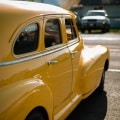
The heart of the film is John Milner’s canary-yellow chopped ’32 Ford Deuce Coupe. Milner is the undisputed king of the strip, and his deuce is the fastest thing in the valley, a Chevy 327 tucked inside a pre-war Ford body, which is about as hot rod as it gets. But the movie doesn’t stop there. Harrison Ford rolls in with a menacing black ’55 Chevy 150 looking for a fight. There’s a slick ’58 Impala, a chopped-and-channeled ’51 Mercury custom, and a ’56 Thunderbird. Every frame is a rolling car show.

Milner’s deuce is the textbook example of blending old-school style with modern performance, a philosophy every builder understands. If you’re working on a classic and want to add modern convenience without losing the character, Watson’s StreetWorks carries push-button ignition systems, LED lighting, and interior accessories to bridge that exact gap.
Fun Fact: The production snagged the ’32 coupe from a California used-car lot for about $1,300. It was sitting in primer gray with red fenders and needed serious work just to run. The crew pulled the fenders, sprayed it yellow lacquer, dyed the interior black, and created one of the most replicated hot rods in history. After filming, the movie cars were listed in the San Francisco newspaper classifieds and barely drew any interest. The deuce was priced as low as $1,500 with no takers. Imagine that.
2. Two-Lane Blacktop (1971)
The Star Car: 1955 Chevrolet 150 Gasser
Here’s one for the purists. Two-Lane Blacktop is a stripped-down, no-frills road movie starring musicians James Taylor and Beach Boy Dennis Wilson as “The Driver” and “The Mechanic,” two guys who live out of a primer-gray ’55 Chevy 150, drifting from town to town and racing anyone willing to put up cash. They cross paths with Warren Oates in a bright orange 1970 Pontiac GTO, and the two crews agree to a cross-country race for pink slips that never quite reaches its finish line.
The plot is thin by design. What matters here is the car and the road, and the understanding that for some people, the machine is the life. The ’55 Chevy in this film is no show pony. It’s a purpose-built drag car, mean and functional, and it absolutely dominates every scene it’s in. This is one of the most authentic hot rod movies ever made, and it’s required viewing for anyone who’s ever chosen horsepower over a paint job.
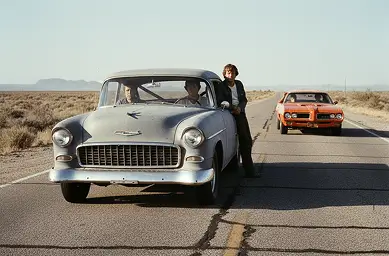
The Driver and The Mechanic understood that what’s under the hood is everything. If you’re wiring up a serious build where reliability isn’t optional, Watson’s StreetWorks’ relay kits and universal wiring looms keep your electrical system clean and dependable.
Fun Fact: Fabricator Richard Ruth built three ’55 Chevys for the production, two loaded with tunnel-rammed 454 V8s and one with a 427, all paired with Muncie M22 “Rock Crusher” four-speeds and serious drag-race modifications. He originally painted them powder blue, but director Monte Hellman ordered them sprayed in primer gray, reasoning that these characters would pour every dollar into the mechanicals and nothing into cosmetics. After Two-Lane Blacktop wrapped, the surviving cars sat in Universal’s prop lot until producer Gary Kurtz pulled two of them out and repainted them black for Harrison Ford to drive in American Graffiti. Same cars, two legendary films.
3. Bullitt (1968)
The Star Car: 1968 Ford Mustang GT 390 Fastback
No list of the best car movies would be complete without Bullitt. Steve McQueen plays a stone-cold San Francisco detective chasing hitmen through the city’s famous hills, and the resulting 10-minute pursuit between McQueen’s Highland Green Mustang GT and a black 1968 Dodge Charger R/T is widely considered the greatest car chase ever filmed.
No CGI. No digital trickery. Just real cars at real speed on real streets, with the camera mounted low enough that you feel every bump and gear change. The chase set a new benchmark for automotive stunts in cinema, and it still holds up beautifully. McQueen reportedly did some of his own driving, and the raw, unpolished feel of the sequence is exactly what makes it timeless.

McQueen’s Mustang was the definition of understated muscle: no stripes, no scoops, just clean lines and serious power. If that’s your build philosophy, Watson’s StreetWorks’ billet-finished power window switches and interior trim add modern function without cluttering up the aesthetic.
Fun Fact: Two Mustangs were used for filming, a “hero” car for close-ups and a stunt car that took the beating. The stunt car was reportedly sent for scrapping after production, but was later discovered in a Mexican junkyard. Meanwhile, the hero car disappeared from public view for decades before resurfacing in 2018. It sold at auction in 2020 for $3.74 million, one of the most valuable American cars ever sold at public auction.
4. Christine (1983)
The Star Car: 1958 Plymouth Fury
Stephen King wrote the novel. John Carpenter directed the film. And a blood-red 1958 Plymouth Fury became one of the most recognizable cars in movie history, no human co-star required. Christine is a possessed automobile that seduces its nerdy teenage owner and then systematically destroys anyone who threatens their relationship. She rebuilds herself after every act of violence, emerging from the wreckage gleaming and perfect.
It’s a horror movie, sure, but it’s also a love story between a kid and a car, and if you’ve ever spent months bringing a neglected classic back to life, you understand the obsession, even if your car hasn’t tried to kill anyone. Christine single-handedly pulled the ’58 Fury out of obscurity and turned it into a collector icon.

Christine could rebuild herself, but the rest of us need good parts. Watson’s StreetWorks’ door latches, hinges, and interior trim components make it considerably easier to bring a neglected classic back from the dead, no supernatural assistance required.
Fun Fact: King chose the ’58 Fury because he considered it a “forgotten car.” Only about 5,303 were produced, and the factory models only came in Sandstone White with a Buckskin Beige interior, not the iconic red. Carpenter’s production went through roughly 24 Plymouth models (including Belvederes and Savoys dressed to match), and the famous self-repair scenes were achieved by using hydraulic pumps to crumple the body panels inward, then running the footage in reverse. About 15% of the film’s entire budget was spent on the cars alone, and by the time cameras stopped rolling, all but two had been destroyed.
5. The California Kid (1974)
The Star Car: 1934 Ford 3-Window Coupe
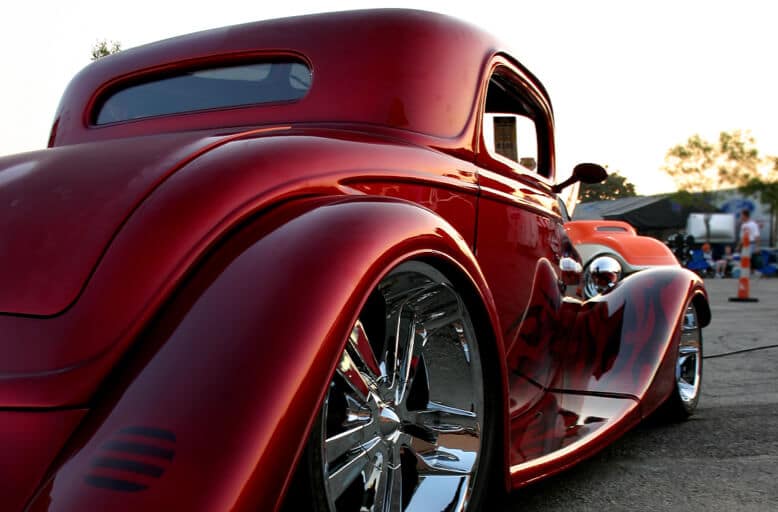
This made-for-TV movie punches well above its weight. Martin Sheen rolls into a corrupt desert speed-trap town driving a flame-painted ’34 Ford 3-window coupe, looking to settle a score with the murderous sheriff (Vic Morrow). It’s tight, it’s mean, and the car is absolutely magnificent.
The ’34 Ford used in the film was built by legendary hot rodder Pete Chapouris, and it wasn’t just a movie prop. It was a genuine, street-driven hot rod that became one of the most influential cars in the hobby. The California Kid is one of those hot rod movies that features a truly great car and also helped shape the direction of the entire community.

Chapouris proved that a well-built traditional rod never goes out of style. If you’re working on a pre-war Ford and need quality switches, headlight wiring, or lighting components that suit a traditional build, Watson’s StreetWorks’ full catalog is worth a long look at.
Fun Fact: Chapouris’s ’34 Ford became a cover car for several major enthusiast magazines after the film aired and is widely credited with helping launch the “traditional hot rod” nostalgia movement of the 1970s. It inspired a generation of builders to look back at pre-war Fords, flatheads, and flames as the foundation of the hobby. The car is considered one of the most important hot rods ever built, period.
6. Vanishing Point (1971)
The Star Car: 1970 Dodge Challenger R/T
Kowalski is a car-delivery driver who bets he can get a white 1970 Dodge Challenger R/T from Denver to San Francisco in under 15 hours. What unfolds is part chase film, part fever dream: cops, the open desert, a blind radio DJ guiding him along, and one of the most uncompromising endings in cinema history.
The Challenger itself is raw and gorgeous, and it spends nearly the entire movie at wide-open throttle. Vanishing Point didn’t have the budget of a studio blockbuster, but it didn’t need one. The desert highways, the engine, and a man who refuses to stop. That’s the whole movie, and it’s more than enough. Among movies with hot rods and muscle cars, this one occupies its own lane.
Kowalski’s Challenger was stripped of everything unnecessary. When your build is focused purely on performance and reliability, Watson’s StreetWorks’ battery disconnects and relay kits help you keep the electrical system tight, simple, and race-ready.
Fun Fact: Five Challengers were used during production, four white 440 R/Ts with four-speeds and one 383 with an automatic. Most didn’t survive filming. The movie was shot largely on real highways with minimal permits, and the stunt driving was done for real at genuinely dangerous speeds. It became an instant cult classic and cemented the Challenger as one of the definitive muscle car icons.
7. Dirty Mary, Crazy Larry (1974)
The Star Car: 1969 Dodge Charger R/T
Peter Fonda stars in this high-octane chase movie that kicks off with a grocery store heist and never takes its foot off the gas. Fonda starts in a blue ’66 Impala but swaps into the real star halfway through, a screaming lime-green 1969 Dodge Charger R/T, and the rest of the film is one long, tire-shredding pursuit through California farm country.
The stunt driving is aggressive, practical, and beautifully reckless. This is one of the great forgotten chase films of the ’70s, and the Charger absolutely steals the show. If you love seeing real cars pushed to their limits by real drivers on real roads, this one belongs on your watchlist.

When things get intense, you need your cockpit organized and your critical systems at your fingertips. Watson’s StreetWorks’ switch panels and rocker switches keep everything within reach and cleanly mounted, whether you’re on a back road or a back lot.
Fun Fact: Dirty Mary, Crazy Larry was a drive-in phenomenon, actually outperforming The Great Gatsby at the 1974 box office. The car stunts were done with real vehicles at real speed, and the ending remains one of the most shocking in the genre. Quentin Tarantino has named it as one of his all-time favorite car films.
8. Thunder Road (1958)
The Star Car: 1950 & 1951 Ford Custom Sedans
Robert Mitchum stars in, co-wrote, and sang the theme song for this hard-nosed tale of Appalachian moonshine runners outrunning federal agents. Mitchum’s character drives a modified 1950 Ford with a hidden tank for hauling white lightning, and the mountain pursuit scenes, for a late-’50s film, are genuinely gripping.
Of all the moonshine-running movies in cinema history, Thunder Road stands alone at the top. It’s a gritty, no-nonsense film that respects both the cars and the culture they came from. Seeing a stock-looking ’50 Ford pushed hard through mountain roads is a reminder that hot rodding has always been as much about function as flash.
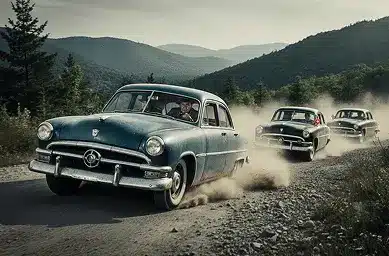
The moonshiners in Thunder Road needed their cars to look bone-stock on the outside while hiding serious capability underneath. That “sleeper” philosophy is alive and well today, and Watson’s StreetWorks’ keyless remote entry systems and concealed push-button ignition let you add modern technology without giving away a thing.
Fun Fact: Mitchum reportedly handled some of his own driving stunts during production. The film was shot on location in the mountains of North Carolina and Tennessee, and real moonshiners served as technical advisors. Thunder Road became a regional hit in the South and played continuously at some drive-in theaters for years, a testament to how deeply it connected with its audience.
9. Hollywood Knights (1980)
The Star Car: 1956 Ford Thunderbird (and a whole crew of cruisers)
Set on Halloween night 1965, Hollywood Knights follows a gang of car-obsessed troublemakers raising hell on the last night their beloved drive-in burger joint is open. It’s crude, it’s funny, and it is absolutely loaded with gorgeous period-correct classic iron from bumper to bumper.
It’s kind of like American Graffiti’s rowdier cousin: less coming-of-age introspection, more pranks and burnouts. The T-Bird gets featured prominently, and the film functions as a rolling car show with a comedy soundtrack. It’s developed a devoted following among enthusiasts who appreciate a movie that puts the cars front and center, and it’s one of the more underrated entries among the best hot rod movies of the era.
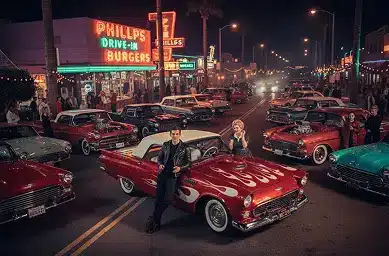
A proper cruise night demands a car that looks as good parked under the lights as it does rolling down the boulevard. Watson’s StreetWorks’ interior lighting, dash vent trim, cup holders, and column accessories are exactly the kind of finishing touches that take a build from “almost done” to “done right.”
Fun Fact: The production assembled an impressive lineup of real, period-correct classics for filming. It also served as an early role for Tony Danza, among others. Despite a modest budget, the film’s wall-to-wall classic car content has kept it circulating among gearheads for over four decades.
10. Gone in 60 Seconds (1974)
The Star Car: 1973 Ford Mustang Mach 1 (“Eleanor”)
We’re talking the original here, the one that H.B. “Toby” Halicki wrote, directed, produced, and starred in himself. Halicki plays an insurance investigator who moonlights as a car thief, tasked with boosting 48 vehicles in a matter of days. The prize of the collection is a yellow 1973 Ford Mustang Mach 1 he calls “Eleanor.”
The film’s legendary 40-minute chase sequence tore through real streets and wrecked 93 cars in the process. It’s unpolished, chaotic, and absolutely electric, the kind of independent, seat-of-your-pants filmmaking that couldn’t happen today. Among iconic car movies, the original Gone in 60 Seconds remains one of the most visceral and unfiltered.
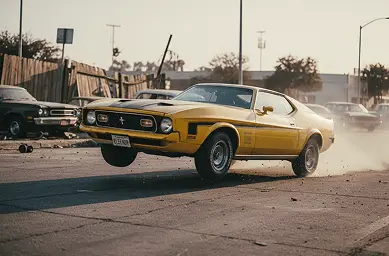
Forty-eight cars is a lot of ignition work, but please, keep it legal. If you’re upgrading your ride’s starting system the right way, Watson’s StreetWorks’ push-button start with RFID technology gives you a secure, modern, keyless ignition that’s a whole lot more legitimate than Halicki’s methods.
Fun Fact: Halicki performed virtually all of his own stunt driving and funded much of the carnage out of his own pocket. Much of the car damage was unscripted, real impacts with real vehicles on real streets. The original “Eleanor” Mustang survived production and became one of the most recognized movie cars in history. The 2000 Nicolas Cage remake is worth a watch too, with a stunning ’67 Shelby GT500 stepping into the Eleanor role.
Build Your Own Movie-Worthy Ride With Watson’s StreetWorks
Every one of these films started with a great car, and every great car starts with the right parts. Whether you’re deep into a restoration, adding modern upgrades to a classic, or building something from bare metal, Watson’s StreetWorks has the innovative hot rod parts and accessories to make your ride worthy of the big screen.
From push-button ignition and power window switches to LED lighting, wiring solutions, door hardware, and interior trim, Watson’s StreetWorks has been helping custom builders create award-winning rides for years.
Frequently Asked Questions About Hot Rod Movies & Watson’s StreetWorks
Can Watson’s StreetWorks parts help me build a movie-inspired hot rod?
Absolutely. Whether you’re building a tribute to Milner’s ’32 deuce from American Graffiti or putting together a clean, menacing cruiser inspired by Bullitt, Watson’s StreetWorks carries the kinds of parts that bring a build together. Our catalog includes push-button ignition systems, billet power window switches, LED lighting, interior trim, wiring looms, and more, all designed to add modern function and quality to classic vehicles. You won’t find body panels or engine blocks here, but when it comes to the electrical, interior, and finishing details that make a hot rod truly complete, Watson’s has you covered.
Are Watson’s StreetWorks parts compatible with both vintage and late-model hot rods?
They are. We design our products with versatility in mind, so whether you’re working on a pre-war Ford, a ’50s Chevy, or a later-model muscle car build, our parts integrate cleanly across a wide range of vehicles. Products like our universal wiring looms, relay kits, and switch panels are built to work in just about any custom application, and their push-button start systems with RFID technology bring modern convenience to any era of vehicle.
What kinds of parts does Watson’s StreetWorks carry for custom hot rod builds?
Watson’s StreetWorks focuses on the components that give a custom build its fit, finish, and functionality. Our product lineup includes push-button ignition systems, power window switches, LED interior and exterior lighting, rocker switches and switch panels, fuse panels, relays, and flashers, door latches, and hinges, interior trim pieces like dash vents, cup holders, and column covers, keyless remote entry systems, battery disconnects, and universal wiring looms. We also carry products from trusted brands like E-Stopp, Trique, Carolina Custom, and Dakota Digital.