

Gettin’ off the Juice
Get a PDF Download of this article here.
Gettin’ off the Juice
by Steve Watson, Watson’s StreetWorks
Replacing a Hydraulic Brake Switch with an Adjustable/Mechanical Unit
How many times am I going to let it happen this year? How many times will some guy yell at me on the freeway,
“Hey buddy! Your brake lights are out!”
How many times will I have to jack up the old buggy, crawl under in the standard mechanics position – face up –
under the master cylinder to once again change that hydraulic brake switch?
How many times will I have to open up the brake fluid system and bleed the brakes – just the front ones if I’m really lucky.
How many times? Never again!
I’m going to fix it right this time.
And what’s with these things anyway? Why do they burn out? A quick call to Watson’s StreetWorks gave me the answer.
It seems that they have been working for years to help people get rid of the hydraulic switches and replace them with their adjustable
mechanical brake switch. Carol Watson explained it to me this way, ” Hydraulic switches are usually only rated at about 4 to
5 amps max. Internally, they have butt type contacts. When the system is pressurized, a little disc inside the switch moves up to
touch the two contact pins.

When this happens, a small arc occurs and the arc causes carbon and oxides on the contacts.
After repeated use, these build up and require more and more pressure to make the electrical connection. Eventually,
the switch stops working all together. If you cut a bad one in half, you can see the buildup on the disc and contacts.
She hooked me up with one of their switches. It is meant for the through-thefloor-board type pedal on my ’34 and has an
adjustable arm so that I can set how quickly it will turn on the brake lights. That’s very important for two reasons – for getting faster
response time to the guy following and for tripping cruise control without needing to pressurize the brake system.
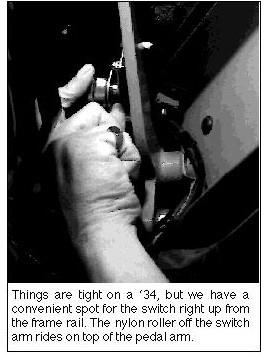
It also has wiping type contacts that help to keep themselves clean, and double the amperage of my old switch. A nylon roller
sits at 90-degrees off the switch arm and gives a low friction surface for the brake pedal arm to contact.
The accompanying photos pretty well show just how easy it is to install. A spot about 5 inches from the pedal-arm pivot
was convenient. Drill two holes through the floor, attach the switch with the stainless hardware included, pop on the
same wire leads as were on the old switch (new terminals are included, too) and we’re half way home.


Adjustment required the use of your classic low tech wood block (not included with the switch but readily available in our shop). The
block goes under the pedal arm to simulate where in the pedal travel we want the switch to activate. Move the switch arm to match, tighten and it’s done!

This switch is rated for 8 to 10 amps. Had we been running halogen brake lights, Watson’s recommend using a relay as well.
But for our 1157 bulbs or for LED brake lights, a relay isn’t needed.
Wish everything on the rod went in as easy and worked as well.
Get a PDF Download of this article here.